I tell you what to automate in your business, what to leave alone, and in what order.
An AI diagnostic for businesses that already have customers, processes, and a mess.I look at how you work today, where your time goes, and what data you actually have, then hand you a document with the exact order of what to do. If you want, I implement it afterward.
Businesses across Latin America and the United States, in Spanish or English.
You’re probably in one of these three
You answer the same messages every day.
Hours, prices, availability, “do you still have it?”. It eats your morning and you still lose customers because you didn’t get to them in time.
You have information, but it’s scattered.
Orders in WhatsApp, payments in a notebook, customers in somebody’s head. You know there’s something useful in there, but you can’t see it in one place.
You already tried an AI tool and it didn’t stick.
You paid for it, nobody on the team used it, you canceled two months later. The tool wasn’t the problem. Nobody checked first whether the process was ready for it.
If none of these sound like you, you probably don’t need me yet. I’d tell you the same thing on the call.
What the diagnostic is
One to three weeks of work, depending on the size of your business, ending in a document that belongs to you. Not a sales call in disguise and not a nice-looking deck: a map of how your business actually runs today and what’s worth changing first.
The six phases
Kickoff
We agree on scope and, more importantly, the baseline — today’s numbers. Without it there’s no way to prove later whether anything worked.
Process audit
How people actually work, not how the manual says they do. Interviews and a map of the processes with the most friction, drawn in BPMN, the international standard for documenting processes.
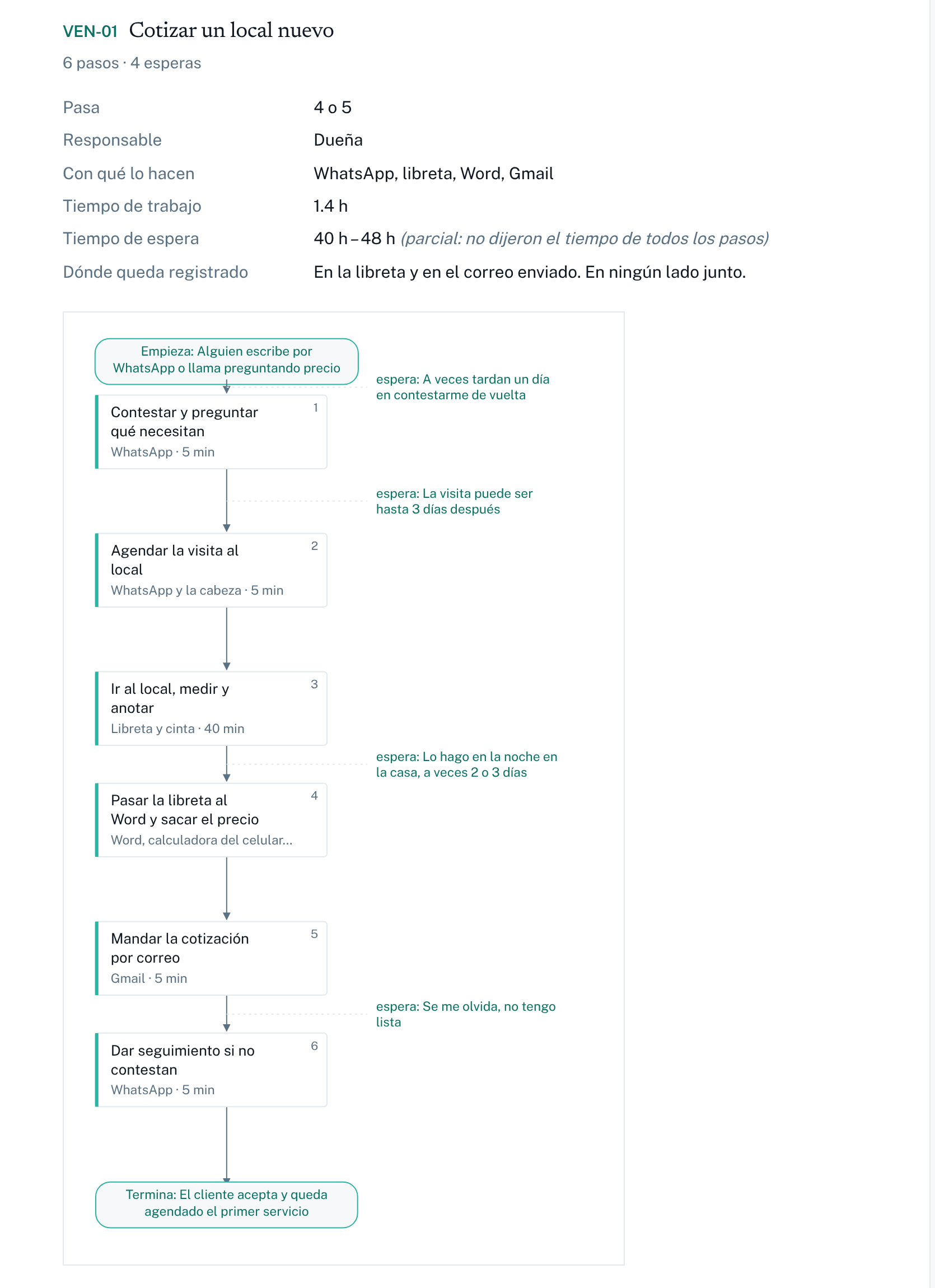
One of your process maps: every step, the tool it uses, how long it takes, and where it sits waiting. Sample data. Opportunities
What can be automated, with what, and how much time or money each one gives back.
Risk review
What breaks if we do it. Where your data lives, who touches it, what happens when an automation fails on a Tuesday afternoon.
Roadmap
The order. What happens in the first weeks, what in the first quarter, what gets piloted before it’s installed for real.
30–60 day review
We measure against the baseline again. It happens either way, even if you run the roadmap yourself, and it isn’t billed separately.
What you get
- A one-page executive summary: where you stand, the three main findings, and the estimated savings.
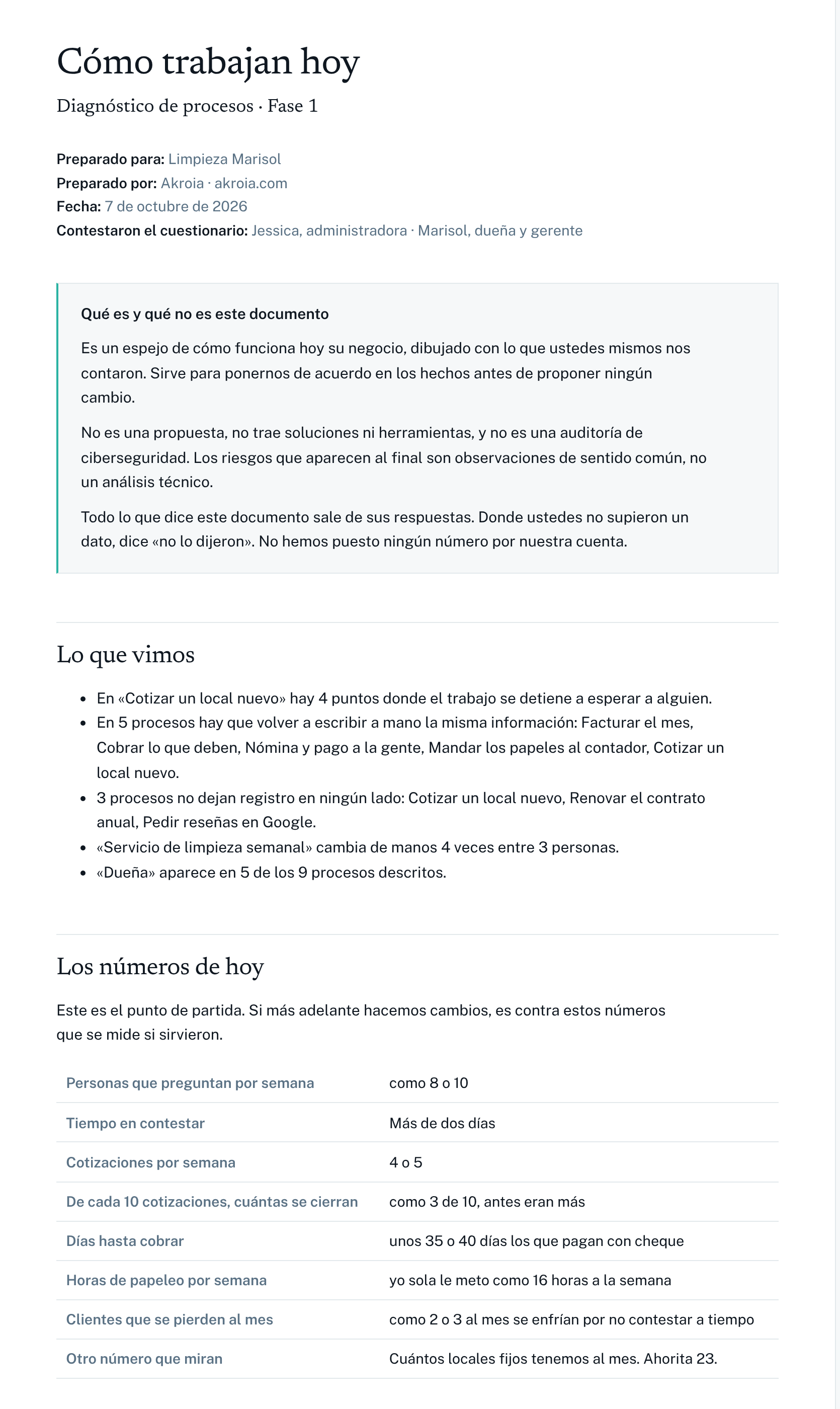
- The full document, as a web page with everything in it that you can print or save as a PDF, with your key process maps as images and as BPMN files.
- The opportunity list ranked by effort and return, with what each one costs and how to measure it.
- A data risk review for every automation proposed.
- A phased roadmap with success criteria for each pilot.
All of it in a folder that’s yours, plus a 45 to 60 minute meeting where I walk you through it and you decide what’s next.
What I need from you
- A questionnaire that takes 30 to 45 minutes before we start.
- One 60 to 90 minute session for Express, or two or three for Full, with the people who actually do the work, not just the owner.
- Real examples: a quote, an invoice, a typical message, with personal details covered up.
I never ask you for passwords, not by email and not by message.
Two formats
- Express
- 1 to 5 people, a trade or a very small business. One or two key processes, a single interview session, delivered in a week.
- Full
- Several departments or a larger team. Multiple interviews, more processes reviewed, delivered in two or three weeks.
What it isn’t
The risk review covers your data and your automations. It is not a cybersecurity audit or a penetration test, and it does not replace legal advice.
From USD 500, depending on the size of the business and the format. If you then decide I should implement what comes out of the roadmap, half of what you paid comes off the installation. You have 60 days to decide.
What comes out of the diagnostic actually gets built
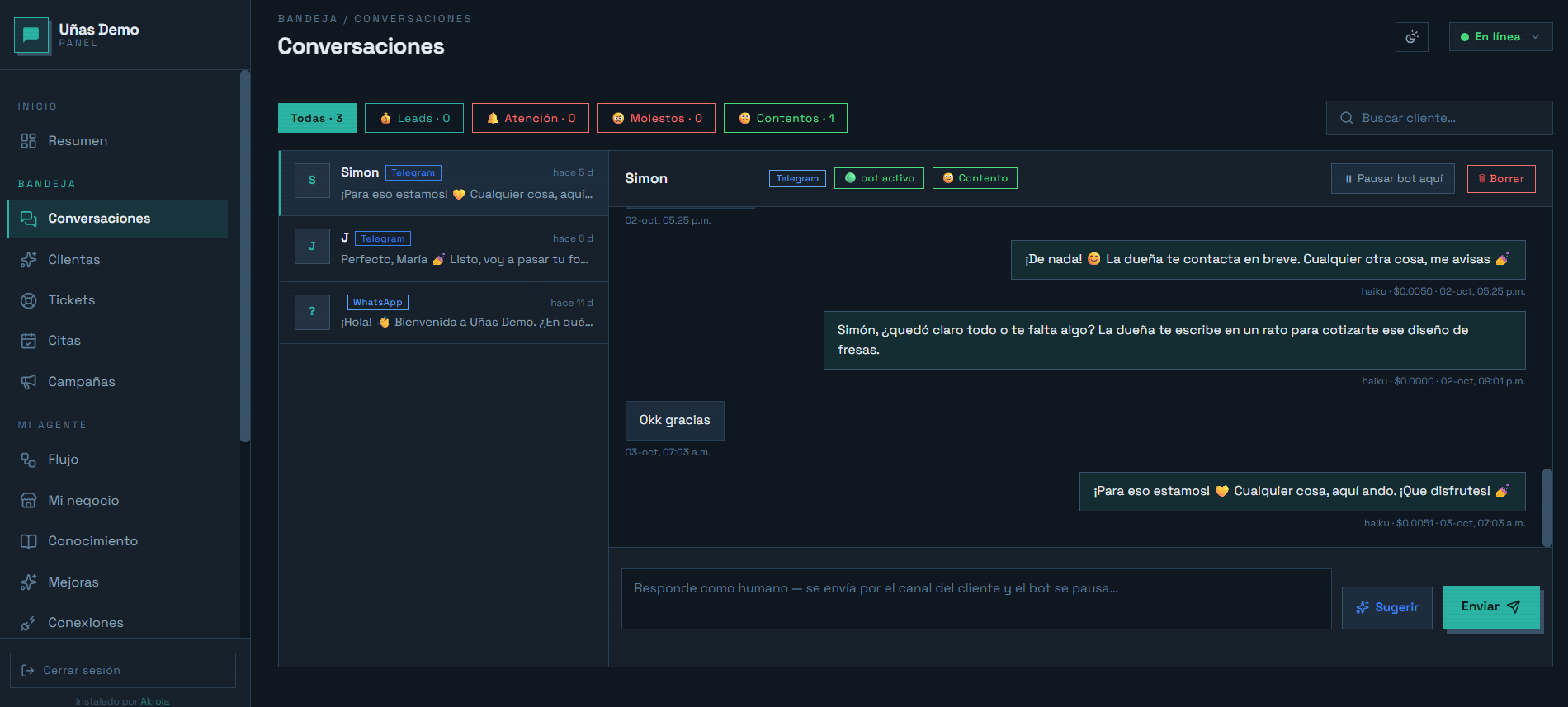
The service already running in production is the customer-service chatbot. It answers your customers using your business’s real information, takes appointment requests and hands them to you, and knows when it doesn’t know.
Three things it does differently
It doesn’t make things up.
Before sending any reply it checks that the prices, hours, and phone numbers it’s about to say are actually in your information. If they aren’t, it says it will confirm and leaves you a note. That’s the difference between a bot that helps and one that gets you in trouble.
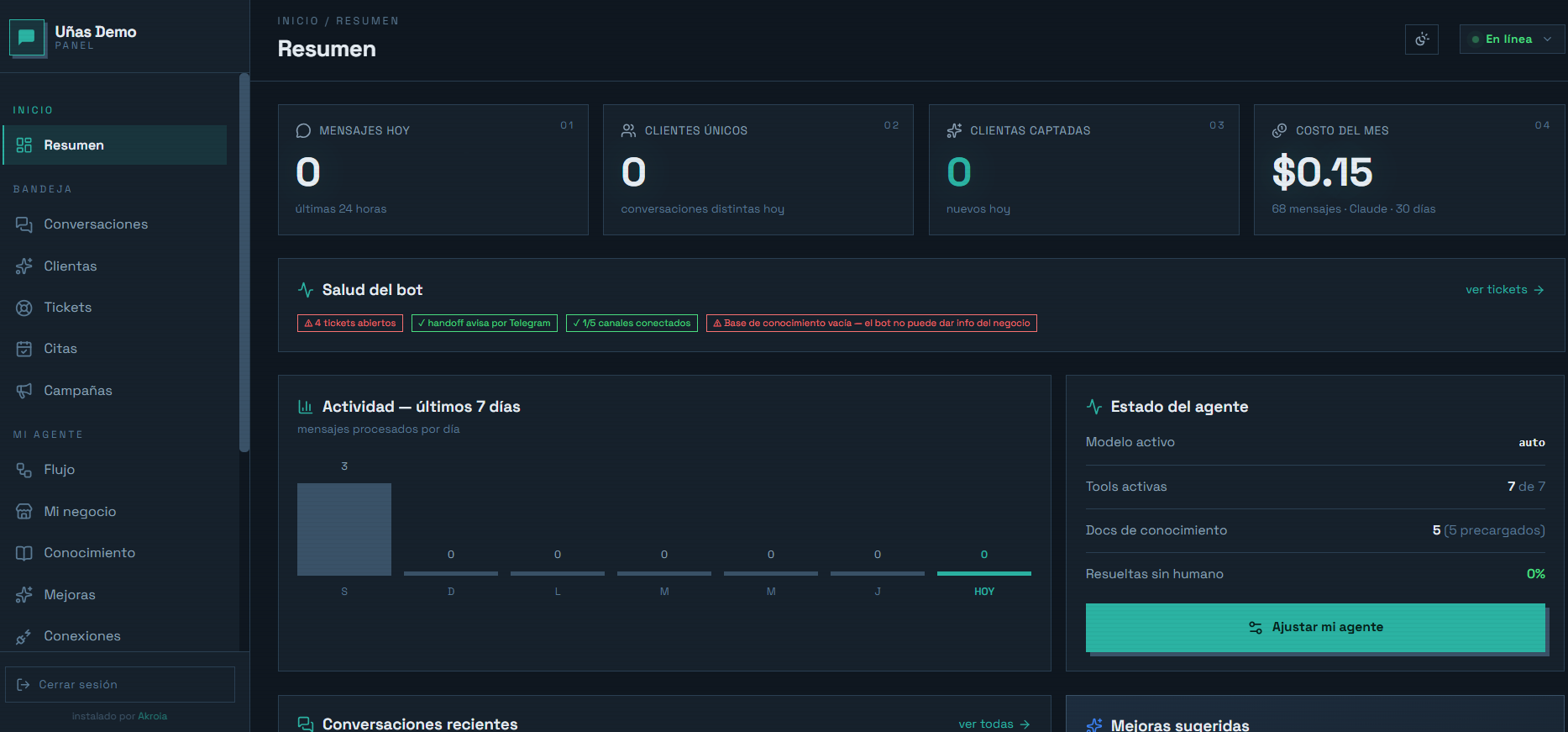
The home screen: how many messages came in, what you’ve spent, and what the bot still needs to work better. It never confirms an appointment on its own.
It takes the details, saves them as a pending request, and alerts you. You confirm from the dashboard, and the bot replies to your customer on whatever channel they wrote from.
It knows when to stay quiet.
If the customer asks for a person, or the topic is sensitive, it hands the conversation to you and stays silent for an hour so it doesn’t talk over you. Then it picks back up on its own.
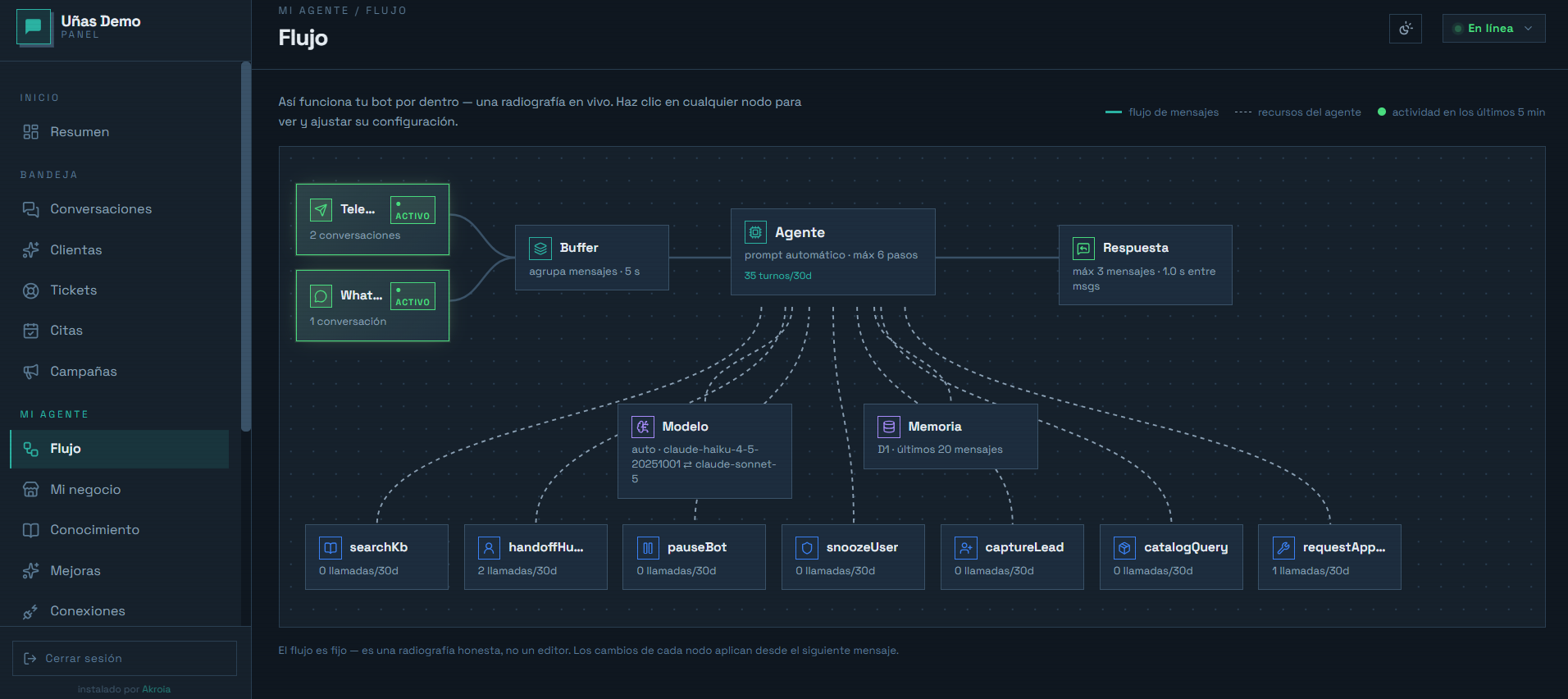
The bot from the inside, no mystery: where a message comes in, which model answers it, and what it’s able to do.
The bot is installed in an account in your name, with your own AI key. Your customers’ conversations, phone numbers, and appointments are stored in your database, not mine. If you ever leave, the account and the data stay with you — there’s nothing to recover from anywhere else.
What usually comes out of the roadmap
Every diagnostic turns out differently. These are the things that land in the roadmap most often, and that I can build:
- Chatbots and support agents for WhatsApp, Instagram, Messenger, and the web
- Voice agents for phone calls
- Automations between the tools you already use
- Custom CRM and inventory platforms
- Websites and forms
- SEO and GEO — being found on Google and inside AI assistants’ answers
- Video editing and carousels
- Team training, which is usually the missing piece
Running it with me is a monthly membership with a block of hours, no lock-in. I can also train your team to build it themselves, or you can run it on your own with the roadmap in hand.
If an off-the-shelf tool solves your problem better, I’ll tell you and help you pick it, even when that means you don’t hire me to build anything.
Who’s behind this
I’m Robert. Akroia is my consultancy: diagnosis, implementation, and ongoing support, with a fixed method instead of improvisation.
Besides what I install for clients, I built and maintain two products of my own in production: Zhois, a management platform for independent professionals, and ObraSign, a jobs, estimates, and contracts app for contractors. I build those to the same standard I bring to your business.
What people ask before hiring me
How much does the diagnostic cost?
From USD 500, depending on the size of your business and whether it’s Express or Full. You get the exact number on the call, before you commit to anything.
What if the diagnostic says I don’t need AI?
Then I’ll say so. It’s a valid outcome and it happens. If something off the shelf solves your problem, I’ll recommend it even though there’s no work in it for me.
Does the diagnostic come off the price if I hire you?
Half of it comes off the installation of the first service in the roadmap, within 60 days of delivery. It doesn’t apply to the monthly membership or to what you pay vendors directly.
Do I need to be technical?
No. The work is understanding how your business runs. The technical part is mine.
How long does it take?
Express, one week. Full, two to three. The results review happens 30 to 60 days later.
What happens to my data?
Everything I install lives in an account in your name, with your own keys. You pay those vendors directly, and I only have access while the installation and the membership you hire are running.
Do you work on site?
Remotely, with businesses across Latin America and the United States, in Spanish or English. For the Full format there can be site visits when the business has physical operations nearby.
What if I already have a CRM or point of sale?
Even better. The diagnostic starts exactly there: what you have, what the team actually uses, and what data you’re already collecting without realizing it.
What happens after the diagnostic?
Three paths, all of them fine: a monthly membership with a block of hours to run the roadmap phase by phase, no lock-in; training for your team if you have people who’d rather build it; or you run it yourself. In all three the 30 to 60 day review happens anyway.
What happens to the information I show you?
Before the first interview we sign an agreement: confidentiality both ways, the final document is yours to use however you want, and when we finish I return or delete whatever you shared with me. I never ask for passwords.
How do I pay?
Half when we sign and half on delivery. Anything from third parties — Cloudflare, your own AI key, whatever’s needed — you pay the vendor directly, never through me.
Let’s talk for 20 minutes
Tell me what’s eating your time and I’ll tell you whether the diagnostic makes sense for your case. If it doesn’t, I’ll say that too.
Rather pick the time yourself? Book directly here → (opens in a new tab)
Or email me at principal@akroia.com.