The diagnostic, step by step
This is the long version of what the front page says. If you’re going to pay for a diagnostic, you deserve to know exactly what happens each week, what I’m going to ask you for, and what you’re left holding at the end.
The result isn’t a deck. It’s a document that belongs to you, in a folder that belongs to you, and you can run it with me, with your team, or with anyone you like.
The six phases
Kickoff
What happens: we sign the agreement — confidentiality both ways, the final document is yours — and settle the scope and the main goal. Then we set the baseline: today’s numbers. If you don’t have numbers, we pick two or three that can actually be measured and start measuring them.
What I ask for: a questionnaire that takes 30 to 45 minutes, plus whatever numbers you already have. How many messages you answer a day, how many appointments fall through, how long a sale takes to close.
What you keep: the signed agreement and a one-page summary of the goal and the baseline. That’s what everything gets measured against in phase 6.
Process audit
What happens: interviews with the people who do the work, not only with you. We draw out, step by step, the processes where time disappears, look at where your data lives today, and find which tools the team actually uses — rarely all the ones you’re paying for.
What I ask for: one 60 to 90 minute session for Express, or two or three for Full, with the people doing the work. And real examples with personal details covered up: a quote, an invoice, a typical customer message.
What you keep: a map of your key processes as images you can print and pin up, an inventory of what you use, and the adoption note: what gets used, what gets paid for and ignored, and the BPMN file for each process.
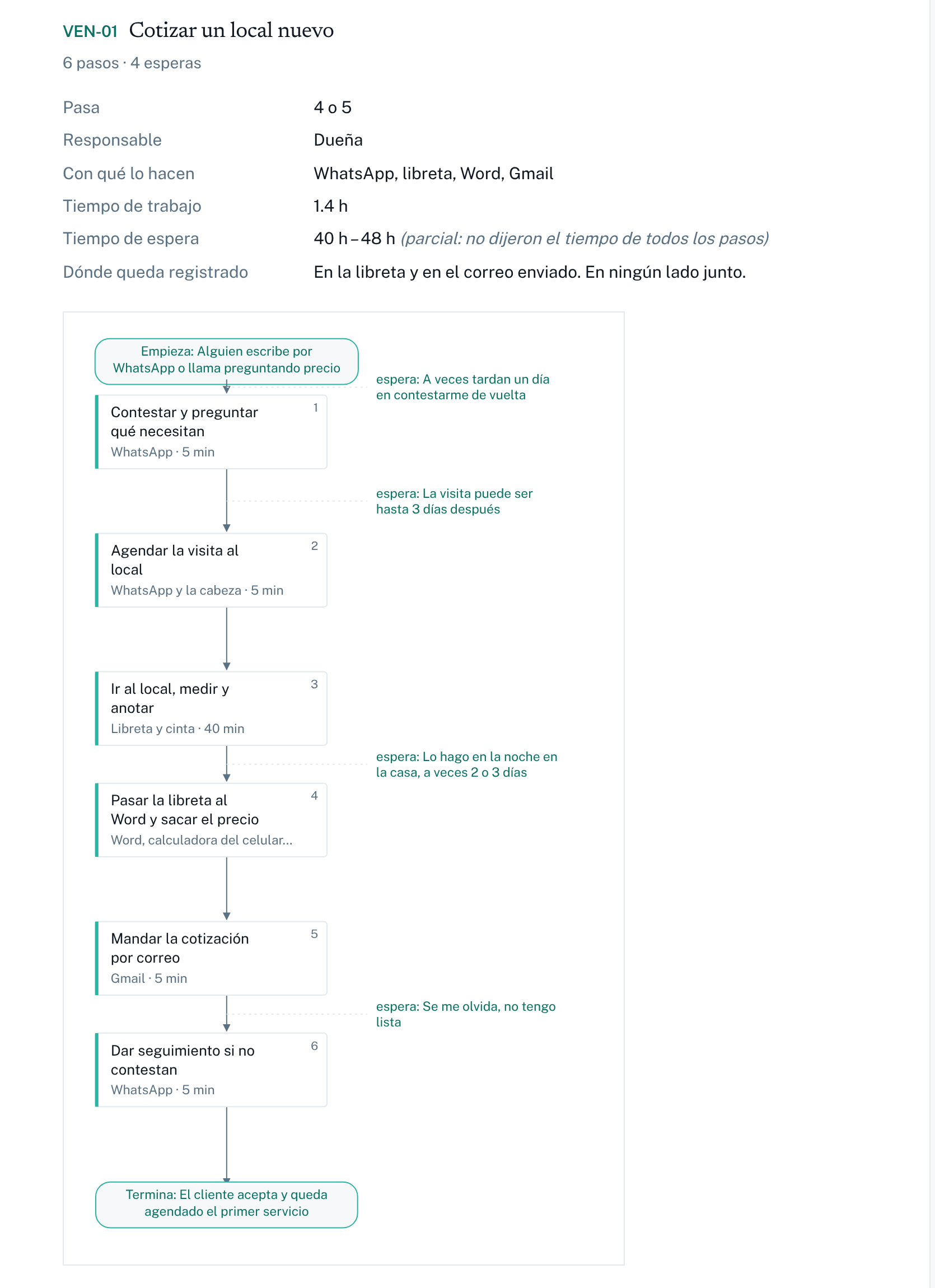
One of your process maps: every step, the tool it uses, how long it takes, and where it sits waiting. Sample data.
Why the map is in BPMN
BPMN is the standard way to draw a process: who does each step, with what, in what order, and where it sits waiting. It isn’t something I made up or the format of one particular program.
- It’s an international standard, ISO/IEC 19510, published in 2013 and still current. No single company defines it; an open body maintains it.
- The file is open XML. It opens in any tool that understands BPMN, today and in five years, with me or without me.
- It helps if you ever go for a quality certification such as ISO 9001, which requires having your processes written down. The diagram doesn’t certify you, but it saves you starting from scratch.
- And it’s useful for teaching. A new hire, a partner, or whoever takes over sees how the work runs on one page, instead of being told three times.
You get both: the BPMN file and the image, so you can use whichever helps.
Opportunities
What happens: every friction point gets checked against three ways out, in this order: fix it without technology, buy something that already exists, or build it. For each one I work out what it gives back, what it costs, and how we’d know it worked.
What I ask for: almost nothing. One short session to confirm I understood your business the way it actually runs.
What you keep: the opportunity list ranked by effort and return, with an approximate cost and a metric for each. Anything that’s an estimate is labeled as an estimate.
Risk review
What happens: what breaks if we do this. Where your customers’ data would sit, who would have access, what happens when an automation fails on a Tuesday afternoon and nobody notices until Thursday. This is also where the things worth checking before you switch anything on come up: call recording, bulk messaging, sensitive data.
What I ask for: who has access to what today. Plus one uncomfortable answer that’s usually yes — whether a business password is still known by someone who no longer works with you.
What you keep: a risk review for every automation proposed, with what to fix before turning it on and what to watch afterward.
Roadmap
What happens: the order. What gets done in the first weeks, what in the first quarter, and what gets tried as a small pilot before it’s installed for real. Every pilot has its success criteria written down in advance, so nobody argues later about whether it worked.
What I ask for: one decision from you. Whether to start with what gives back the most time or with what carries the least risk. Both are valid answers and they change the order.
What you keep: the phased roadmap, with success criteria, estimated cost, and the training your team needs at each step.
Delivery
It all arrives together: the one-page executive summary with the three main findings, the full document as a web page with everything in it that you can print or save as a PDF, the maps as images and as BPMN files, the opportunity list, and the roadmap. Plus a 45 to 60 minute meeting where I walk you through it and you decide what’s next. The folder is yours from that day.
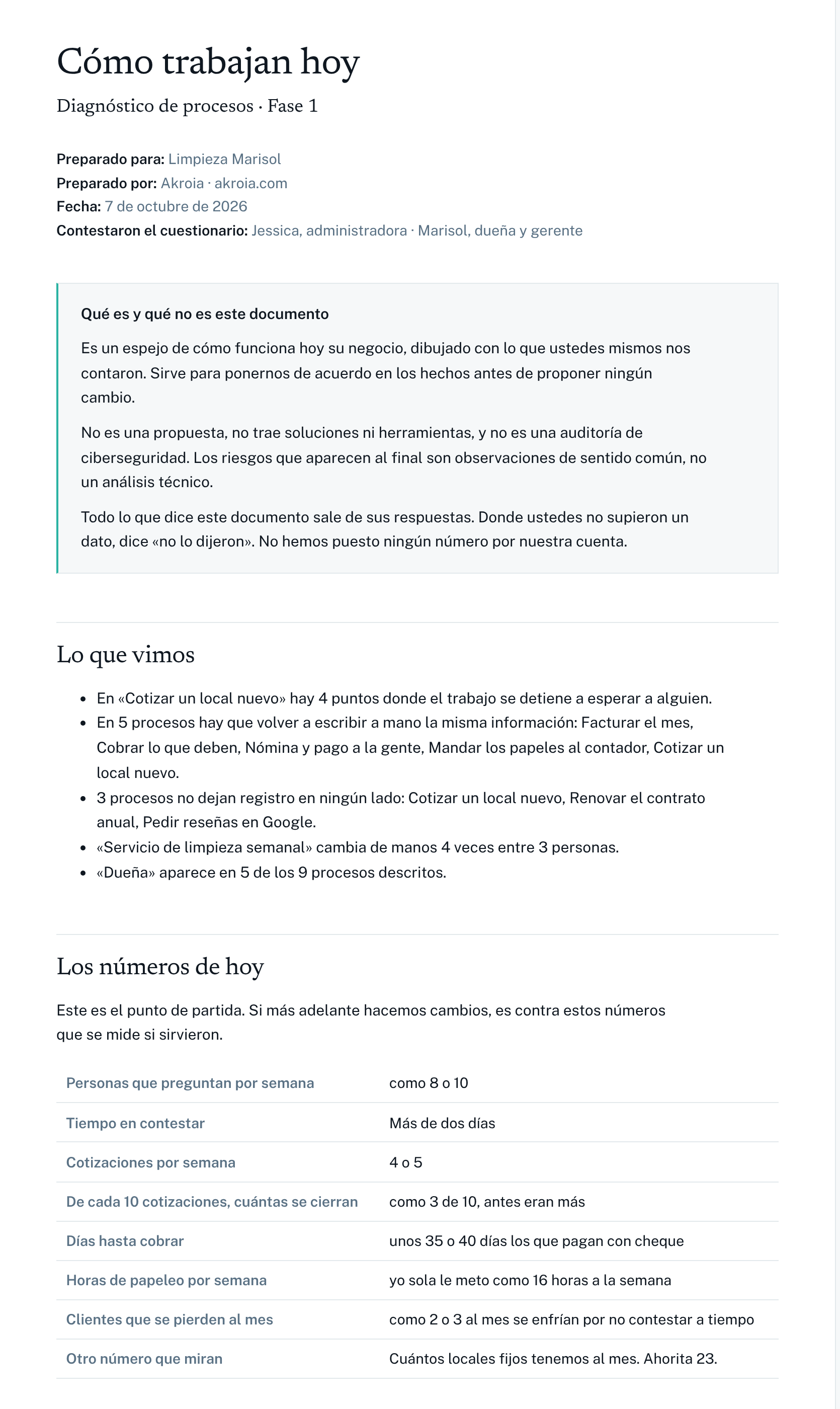
30–60 day review
What happens: we measure against the phase 1 baseline again. What got installed, what worked, what didn’t, and what changes in the roadmap because of it.
What I ask for: the same baseline numbers, one more time.
What you keep: a short results note. This phase happens even if you run the roadmap yourself, and it isn’t billed separately.
How I decide, in all six phases
I don’t make up the criteria fresh for each business. These five rules come before my opinion, and some of them work against what’s profitable for me:
- Measure before you change. Without a baseline you can’t prove anything worked. You can only have an opinion about it.
- Data before AI. If your information doesn’t exist or is scattered, step one is sorting it out. AI on messy data just produces garbage faster.
- People before tools. An automation your team won’t adopt is worth zero, however good it is. That’s why training sits inside the roadmap instead of being sold as an add-on.
- Buy before you build. If something off the shelf solves it well, I’ll recommend it even though there’s no work in it for me.
- Test small. Anything that matters gets validated as a pilot with success criteria before it’s installed in full.
Express or Full
The format changes the depth. It doesn’t change the order of the phases or what has to be true before one closes.
- Express — 1 to 5 people, a trade or a very small business. One or two key processes, a single interview session, delivered in a week, short document.
- Full — several departments or a larger team. Multiple interviews, more processes reviewed, delivered in two or three weeks.
What it isn’t
- The phase 4 review covers your data and your automations. It is not a cybersecurity audit or a penetration test, and I won’t present it as one.
- Anything legal that comes up is a flag for you to verify, not legal advice. If there’s health, biometric, payment, or minors’ data involved, you confirm it with a lawyer or a specialist. I’ll tell you when.
- I never ask you for passwords, not by email and not by message.
- If something in the roadmap is beyond what I do well, I’ll say so and help you find who to subcontract it to. Better you hear that in week one than in month three.
What it costs
From USD 500, depending on the size of the business and the format. You get the exact number on the call, before you commit to anything. Half is paid when we sign, half on delivery.
If you then decide I should build what comes out of the roadmap, half of what you paid comes off the installation of the first service. You have 60 days to decide. It doesn’t apply to the monthly membership or to what you pay a vendor directly.